
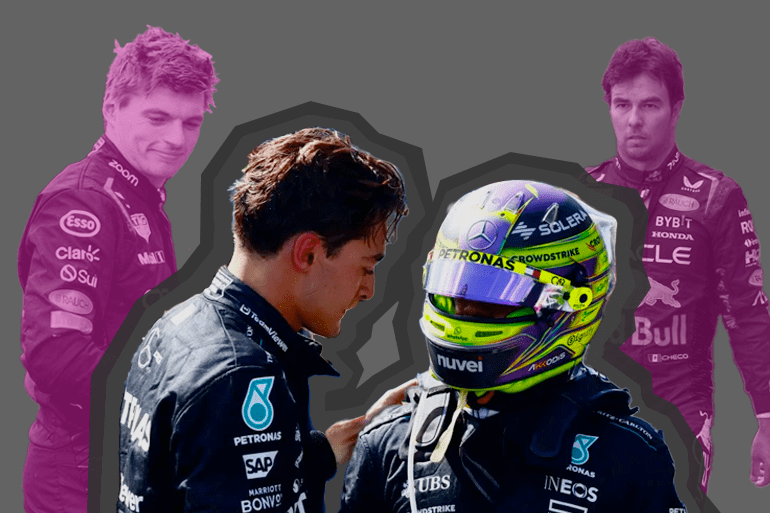
The Belgian Grand Prix saw a few stunning performances from the likes of George Russel and Max Verstappen, however, the low lights from this weekend far overshadowed the highlights.
Winners
My personal top three highlights from this race, from best to worst.
1: Max Verstappen
Max Verstappen started this weekend off with a stellar qualifying followed by a controlled and well-executed race.
Verstappen threw down the metaphorical gauntlet with his first push lap in Q1. Verstappen’s lap time sat on the top of the table for the majority of the session, even as track conditions improved. When McLaren’s Oscar Piastri surpassed his lap time, Verstappen responded quickly, retaking the top spot and ending his session with just under five minutes to go. His lap time would end up being the third fastest in Q1. In Q2 and Q3 Verstappen would again set the fastest time with his first push lap of the session, and those times would remain the fastest time for the entirety of the sessions. Verstappen ended qualifying over half a second clear of the second-fastest lap, set by Ferrari’s Charles Leclerc. Even though Verstappen would start the race from 11th due to an engine penalty, he proved why he was still a favorite to win the Belgian Grand Prix.
While his race itself wasn’t quite the charge through the midfield we’ve come to expect from Verstappen around Spa, his fifth-place finish (which would later be promoted to fourth), was still remarkable given that he started in 11th. Verstappen would finish the race in front of McLaren’s Lando Norris who started the race in fourth, to increase his lead in the driver’s championship. Additionally, Verstappen remained level-headed throughout the entire race, despite the frustration that must have mounted being stuck in several DRS trains.
Coming out of last weekend, Verstappen was criticized for spending too much time on the simulator; this weekend he credited his remarkable qualifying to practicing Spa in the rain on the sim. Verstappen was also criticized for his aggression during the Hungarian Grand Prix, and this weekend he was the picture of composure. Overall, Verstappen is walking away from the Belgian Grand Prix having thoroughly refuted last week’s critiques.
2: Aston Martin
While coverage from this race was mostly dominated by the top four teams battling it out for position, further down the grid, Aston Martin pulled off one of their best Grands Prix since China.
The weekend started strong for the Silverstone-based team, with Fernando Alonso qualifying in ninth, and starting the race from eighth. This result builds on the solid qualifying results from the British and Hungarian Grands Prix. Alonso finished the race in ninth and again was promoted to eighth. Alonso’s result at the Belgian Grand Prix makes it the third straight race where Aston Martin has scored points.
However, where the team earns its spot on this list is on the pit wall. Both Aston Martin drivers pulled off a one-stop this past weekend. Lance Stroll pitted on lap 12, while Alonso pitted one lap later. Both drivers then nursed their hard tyres for more than 30 laps. While this strategy may not have led to a massive points haul for the team, it is what allowed for Alonso’s eighth-place finish and for Stroll to climb up from 15th to 11th on the grid.
Overall Aston Martin showcased excellent strategy and has continued their momentum from the British Grand Prix into the summer break.
3: The Undercut
With the long Kemmel straight leading into the Les Combes corner, overtaking is very much possible at Spa. However, drivers need to get very close to the car in front of them to successfully pass them, making it very easy to defend for the majority of a lap. Perhaps this is why the undercut proved to be such a valuable strategy this weekend.
Among the top four teams, undercutting during the first round of pit stops allowed drivers to either make up positions or prevent their rivals from passing them. Two specific instances highlight the undercut. Firstly, Verstappen dived into the pits on lap ten, five laps later, Norris would pit, coming out behind the Dutch driver. This undercut is what allowed Verstappen to increase his lead over Norris in the driver’s championship. On lap 11, Lewis Hamilton would pit from the lead to protect the position from Leclerc. When Leclerc pitted the next lap and proved unable to overtake on slightly fresher tyres, Hamilton’s earlier pit stop proved to be the superior strategy call.
The strength of the undercut was undoubtedly aided by how difficult overtaking proved to be during the Belgian Grand Prix. This is best demonstrated by Hamilton’s failed late race attempt to catch George Russel despite his 16-lap tyre advantage.
Losers
Here are my top (or bottom) three low lights from Spa-Francochamps
1: George Russel’s Disqualification
In the original draft of this post, Mercedes was top of the list of highlights, however, George Russel’s disqualification overshadows almost all of Mercedes’ other achievements this week and most other events from the Belgian Grand Prix.
George Russel’s race was nothing short of fantastic. Starting from an un-notable sixth on the grid, initially, Russel did not make many inroads after the first round of pit stops. However, around halfway through the race, Russel implored his team to consider the one-stop. This call ended up being the correct one, as Russel rose to the top of the standings when all his other opponents pitted and he stayed out. Even though Russel was the first of the front runners to pit, he managed to maintain first place on one set of hard tires for more than 75% of the race. Russel kept his lead, fending off Hamilton, on much fresher tyres, to cross the line first, giving Mercedes its first one-two of the season and becoming only the second driver to win two races this season. However, this joy would not last, as shortly after the race ended, Russel’s car was found to be 1.5 kg underweight when the mandatory 2.8 litres of fuel were removed.
This disqualification is brutal. Russel won the Belgian Grand Prix on merit for one of his best drives of the season so far but his accomplishment would be undone by a rather simple error. Mercedes failed to consider the possibility of a one-stop when fueling the car, meaning that as more of the hard tyre wore away, Russel’s car became underweight. If Mercedes knew they had under-fueled the car for a one-stop, then they should have never let Russel do one. If Mercedes did not know they had under-fueled the car for a one-stop, then that was an oversight. Either way, Mercedes made an error that ruined what was previously a stellar weekend for the team.
2: Sergio Perez
Last weekend Sergio Perez’s seventh-place finish was worthy of praise, and seemingly forecast a brighter future for the Mexican driver. This weekend, his seventh-place finish might just spell the end of Perez’s career as a full-time Redbull driver.
The difference between the reaction to the Hungarian Grand Prix and the Belgian Grand Prix stems from where he qualified during both races. In Hungary, Perez managed to make up nine places to recover from a Q1 exit. This weekend, in contrast, Perez qualified second and slid down the order throughout the race. Perez’s performance on Saturday placed him in a prime position to podium. However, Hamilton got the jump on Perez right off the line. His race would only get worse from there. On lap 13, he got passed by McLaren’s Oscar Piastri, and again Perez would be passed on lap 22, this time by George Russel. The nail in the coffin for Perez’s race would come when Redbull decided to pit him later that same lap. Perez then had to spend the remaining half of the race trying and failing to fend off Ferrari’s Carlos Sainz, eventually crossing the line in eighth. Perez’s typical strengths of tyre management and defensive driving should have served him well, as it did for many other drivers further up the grid, but seemingly neither skill came into play.
Perez only managed to not get passed in the driver standings by George Russel due to Russel’s disqualification. To make matters worse for the Mexican driver, Visa Cash App RB’s Daniel Ricciardo put in a solid drive to finish just outside of points, which would later be promoted to a tenth-place finish. Coming into the Belgian Grand Prix, Perez’s Redbull seat was under serious threat, and he needed to prove that he was the best candidate to finish out the season. But Perez failed to do that, further increasing the likelihood that he will be swapped out mid-season. Not even setting a new track record on the final lap of the race will be enough to overshadow his overall disappointing Sunday.
3: Ferrari
This weekend Ferrari became the first constructor to reach 10,000 points and scored a podium for Charles Leclerc, however both of these accomplishments only happened due to George Russel’s disqualification. If we look at the actions of the Ferrari team, their performance this weekend could best be described as lackluster.
The weekend started strong for the Scuderia with Leclerc inheriting pole position, however, this position would be lost by the end of lap three. Later, on lap 36, Leclerc would be passed by Oscar Piastri and would be unable to respond. Meanwhile, Carlos Sainz’s incredible 20-lap first stint ended up having no impact as he started and ended the race in the same position. Additionally, Sainz would get passed in the driver’s standings by Piastri, and Mclaren extended their lead over Ferrari in the constructor’s championship.
A lot of news this season has focused on Redbull’s downfall in form as other constructors have closed the gap. However, Ferrari has had a similar, if not worse, fall from grace. The team’s highest finish since Monaco has been third, at the Austrian Grand Prix, and this past weekend, but both of these podiums came as a result of another team/drivers’ error, and not due to the merits of Ferrari alone. While for many other teams, finishing on the podium twice in the last four races would be an accomplishment, this is a far cry from the team’s form earlier in the season and the performance one would expect from Formula One’s most successful team.
 Sports Circuit
Leave a comment